**This is a delayed post and certainly something I should have done months ago…. especially since my last trip was on October 2024**
October 2019 was my first trip to Medjugorje, and quite frankly, I was unsure what to expect. Perhaps it was a great rojak mix of joy, gratefulness and possibly a certain fear of the unknown. Nonetheless, as we gathered at KLIA then, a Priest offered me a quiet piece of advice – he said, “Go without expectations. Don’t worry if you don’t experience what the others see; what you might experience may be different from them all.” I have held those words closely then and even now as I venture to other places as well. As let’s be honest about a few things, when it comes to visiting religious sites, it’s not always about the visions and wonders. Sometimes, it’s about finding stillness in yourself, and in your soul.
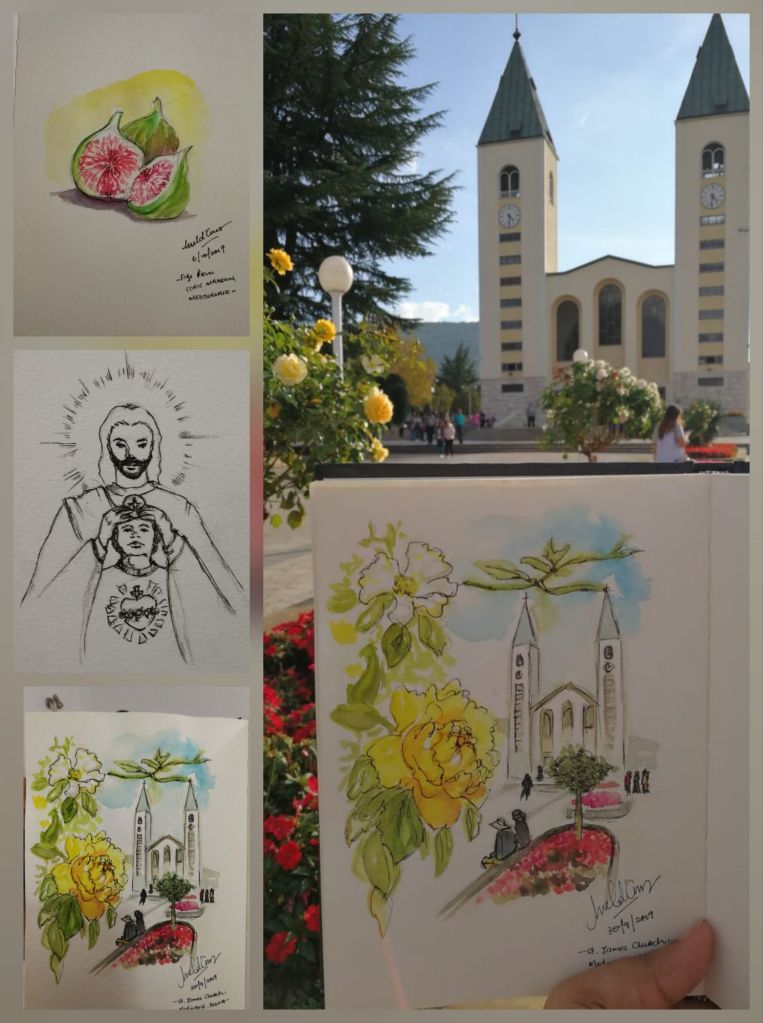
2019: I travelled with my little sketchbook then and illustrated the church in the quietness of the evening.
The essential things in life are seen not with the eyes but with the heart.
Antoine de Saint-Exupéry
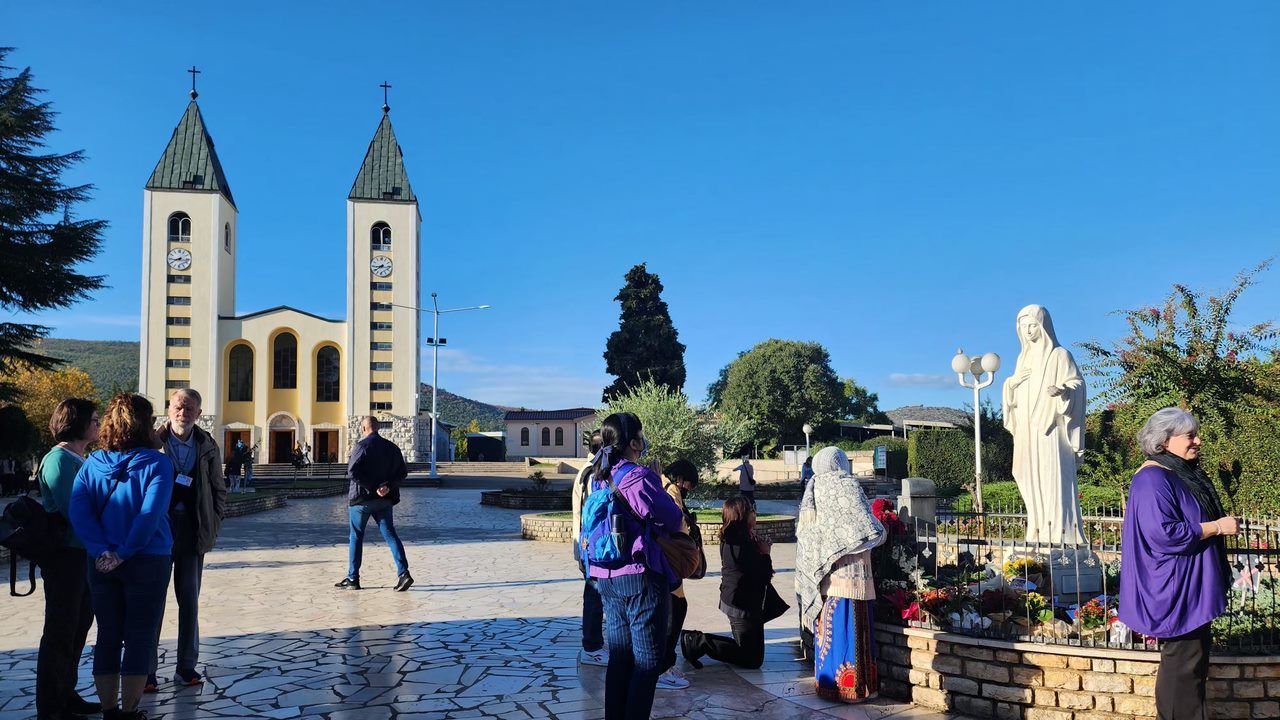
2024: I am back 5 years later and the still serenity calms me still.
Coming forward to 2024, I was once again gripped with a quiet uncertainty about what lay ahead. My encounter from five years ago was not something I expected to replicate—neither the route nor the group I would be travelling with remained the same. So naturally, questions started to flood my thoughts. What would this journey hold for me now? One thing I knew for sure was that my experience would be deeply personal, and markedly different.
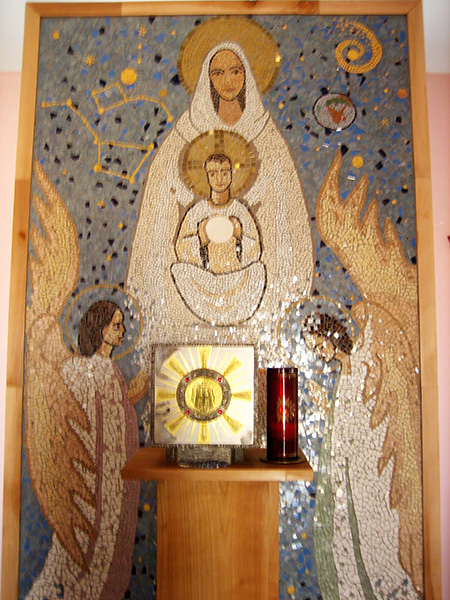
In 2019, our pilgrimage had coincided with the time of the month when Our Lady was said to appear publicly, and I remember how the whole town seemed to hold its breath in reverence. That year, I had the chance to wake up before dawn and make my way to Apparition Hill. We walked briskly in the cool quiet, long before the sun had stirred. At one point, I looked up—and was quietly stunned by how the stars above had arranged themselves into what looked like a celestial pathway. Not leading from us to heaven, but the other way around—as though heaven had gently laid a path down to earth. At the time, I didn’t think too much of it. But the next day, while visiting the Adoration Chapel, I came across a mosaic artwork. In it, the stars were arranged in just the same way, forming a divine bridge from the heavens to us. And that’s when I felt it: that moment had not been coincidence, but perhaps a quiet grace meant just for me.
Mosaic tilework from the Adoration Chapel at Mother’s Village was founded in 1993 by the late Father Slavko, during the war in the Balkans. Source: Medjugorje Center at Canada
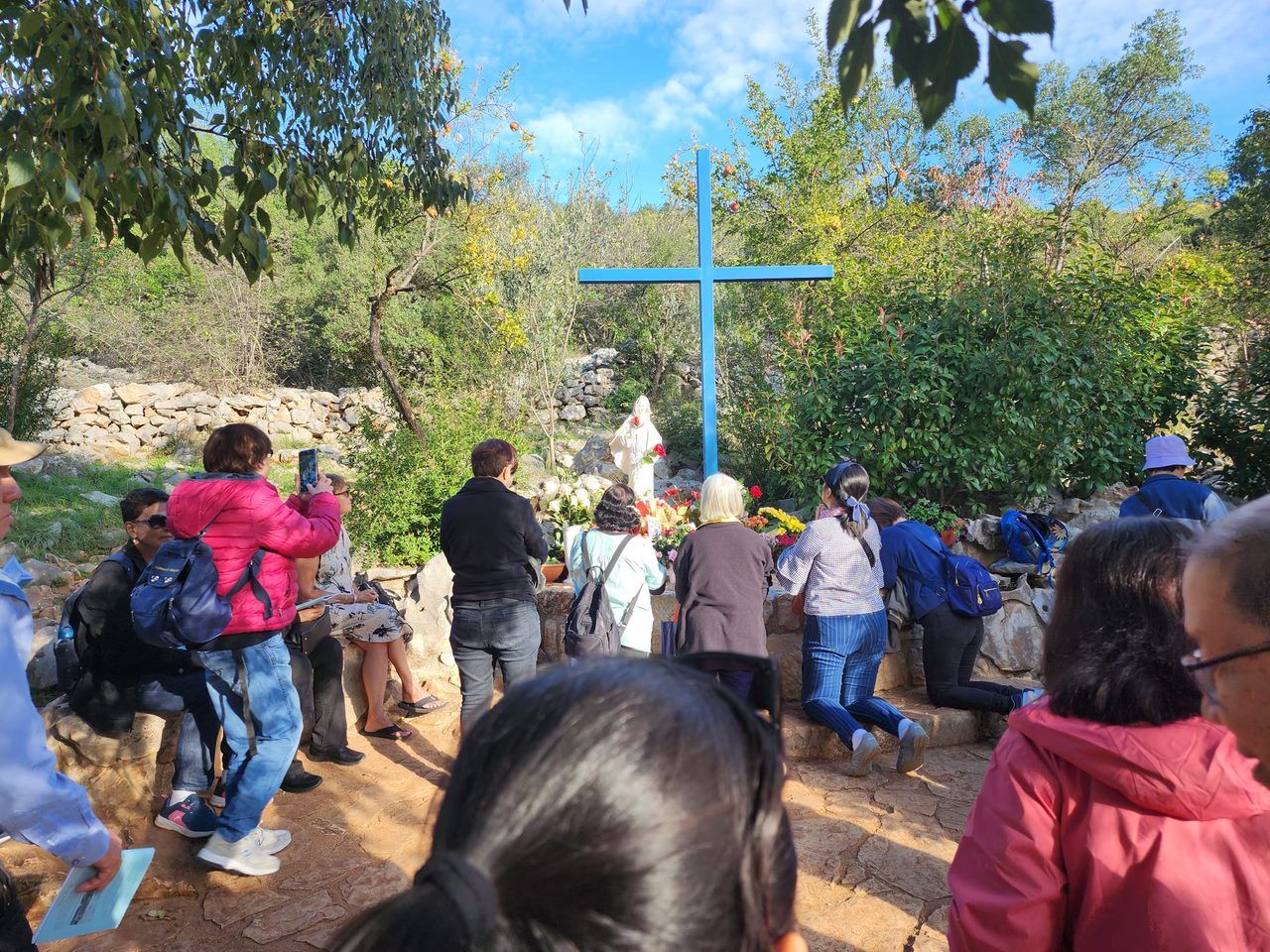
However, that was only the beginning. The true heart of the experience unfolded when we finally reached the Blue Cross at the base of Apparition Hill. It was already packed — pilgrims young and old, from every corner of the globe, clung to every available space. Just like Zacchaeus from the New Testament, some had even climbed up trees in hopes of catching a glimpse or simply being closer to the sacred moment.
And then, it happened.
When Our Lady appeared to the visionary, Mirjana Dragičević Soldo, an extraordinary silence fell upon the crowd — not the hush of a disciplined audience, but a deep, encompassing stillness, like creation itself holding its breath. Even a small bee that had been buzzing near me came to a halt in the air, hovering in quiet reverence, its tiny form turned toward the spot of the apparition.
2024: Climbing up the Hill for a short prayer at the Blue Cross.
In that moment, time simply ceased to matter. I couldn’t tell you how long we stood there, wrapped in that sacred stillness. And just as gently as it had come, the moment lifted. When Our Lady’s message had been delivered and She departed, it felt as though the world exhaled — time resumed, the soft rustle of leaves returned, and life slowly stirred again. What I didn’t know then was that this moment would become even more precious in hindsight. As a few months later, in March 2020, Mirjana received a message that Our Lady would no longer appear to her publicly. It was quietly announced—no fanfare, no grand explanation—just a mother’s gentle farewell, for now.
Looking back, I believe it was a soft warning, a mother preparing her children for what was to come. Shortly after, the world shuttered its doors. Borders closed. Churches emptied. And Medjugorje, once alive with the footsteps of pilgrims, fell into a deep silence. But even as the apparitions to the public ceased, Our Lady did not abandon us. She continued to appear privately to the visionaries, reminding us that grace is not bound by places or crowds. Heaven had not turned its face away—it had simply entered a quieter season. To have been present at that final few public apparition, unknowingly standing on the edge of a new and uncertain chapter for the world, is something I still struggle to put into words.
I didn’t see Her. But I felt Her. And that, I’ve come to realise, is more than enough.
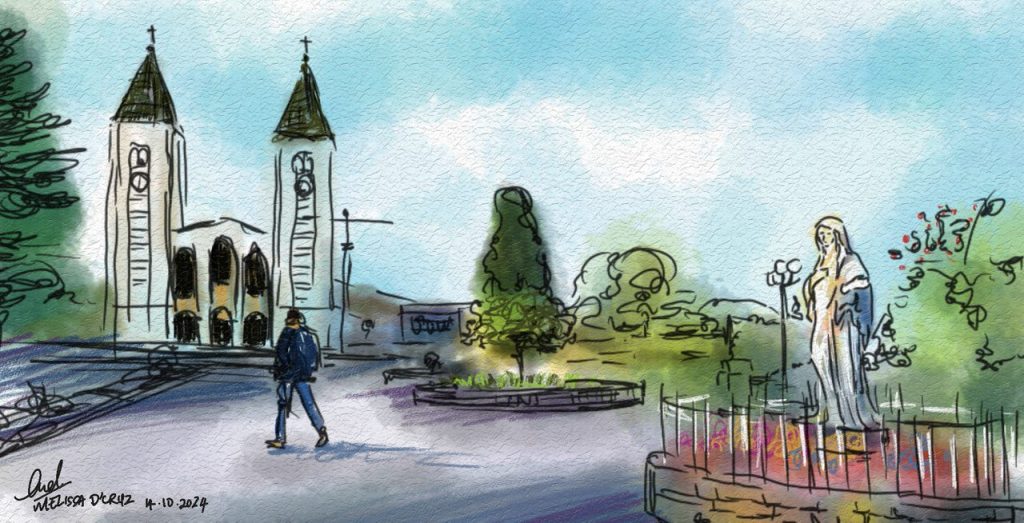
Digital watercolour painting that I had painted the night before we left Medjugorje to head home. App: Infinite Painter, Samsung S22 Ultra.
Though our pilgrimage in 2024 took us further afield, Medjugorje remained our constant—a spiritual hearth we returned to each evening. Despite the years that had passed and the changes the world had weathered, Medjugorje itself seemed untouched by time. The streets still filled with pilgrims. The air still carried the hum of rosaries being prayed in every language. And St. James Church still stood as the beating heart of it all.
What struck me most was how little had changed. The queues for confession were still long, winding their way patiently toward the priest seated in persona Christi—each penitent carrying their own burdens and hope for mercy. It was almost enthralling, witnessing the quiet discipline of those waiting, day after day. There was something profoundly moving in it—the unseen heaviness of hearts being brought to the light, one soul at a time.
“Father, I have sinned…” a moment I was blessed to capture as I stood in line.
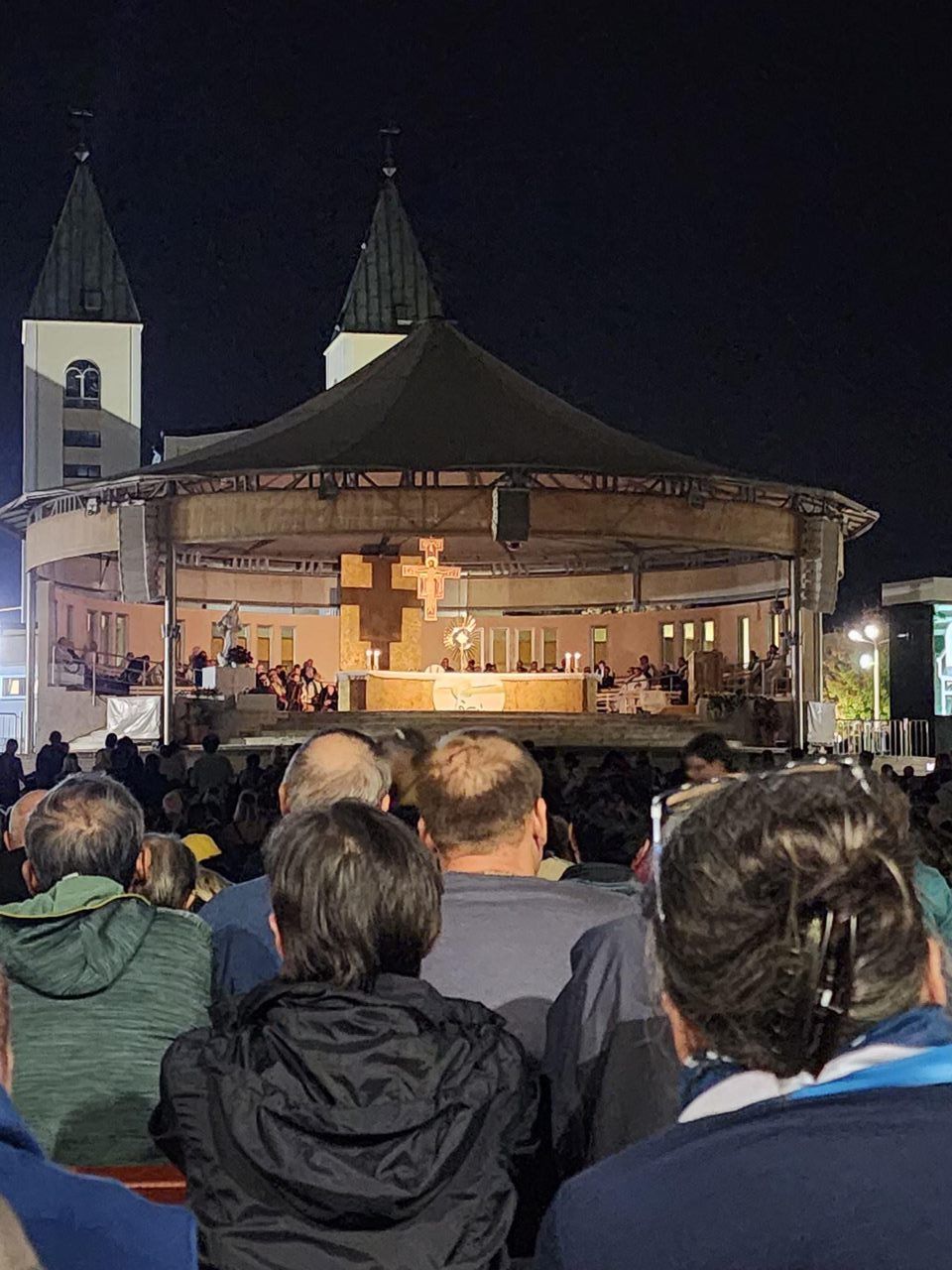
The crowds at Mass never thinned. In fact, each evening as the Liturgy began, the plaza surrounding the church would fill in such a way that you’d pause and wonder where all these people had come from. And when Mass concluded, the dispersing throngs carried with them a kind of invisible thread—a shared experience that needed no words.
Mass followed by Holy Hour and Adoration.
Medjugorje, as it turns out, remains as it always was: a place of encounter. A spiritual current still flows steadily here, whether one is seeking, grieving, or simply watching the stars. And even as we travelled outward to other cities, each return to this little town felt like stepping back into the embrace of something eternal.
This is just the beginning. From Medjugorje’s sacred hills to the ancient streets of Zadar, Dubrovnik, and beyond—each stop carried a piece of grace, a whisper of something divine. Echoes of a Pilgrim’s Soul continues in Part II.
An ode to 10 years at INTI and the ever-changing palate of Subang Jaya.
Ten years is a long time to stay in one place. But somehow, working in SS15—Subang Jaya’s mini metropolitan—never quite felt stagnant. Perhaps because the pavements, alleys, and shophouses around INTI always seemed to be in a state of flux. And more often than not, this transformation was led by food.
When I first started at INTI back in 2014, SS15 was mid-way through a café renaissance. It felt like overnight, every other lot was suddenly pouring “handcrafted” coffee, doling out thick-cut toast, and pairing latte art with raw concrete walls. Artisan cafes mushroomed, each one trying to be the next Instagram darling. It wasn’t just the caffeine—it was the clink of cutlery, the hum of coffee machines, and the soundtrack of lo-fi jazz. ASMR, though not yet a buzzword, was alive and well in the ambiance of these cafés.
Source: Google Images
In-between classes and marking papers, I sipped my way through this golden era. But then came the froyo wave. Frozen yoghurt, or more endearingly, “Froyo”, exploded in popularity. Tutti Frutti was the pioneer of this chapter, letting patrons self-serve by the swirl and pay by the gram. It was yoghurt theatre at its finest. I happily jumped on that bandwagon, like many others, caught in the joy of toppings and tartness. But as with all trends, its reign was brief—melting away as quickly as it came.
Enter: the bubble tea boom. Now, this one had legs. It wasn’t new, of course—any pasar malam kid from the early 2000s would recall slurping on RM5 cups of chewy tapioca pearls. But in the mid-to-late 2010s, the drink rebranded. It became an experience. Names like The Alley, Gong Cha, Daboba, Xin Fu Tang, and Tealive turned boba into a lifestyle. The shops multiplied like mushrooms after rain. I remember walking down the street with a colleague, noticing yet another new outlet under renovation. Jokingly, I muttered, “I hope it’s not another bubble tea joint.” A man nearby—unbeknownst to us, the owner—overheard and asked why. I mentioned the saturation. Months later, the unit never opened. Coincidence? Perhaps. But we did count them, just for fun—27 bubble tea shops in one neighbourhood. A record of sorts.
Source: Google Images
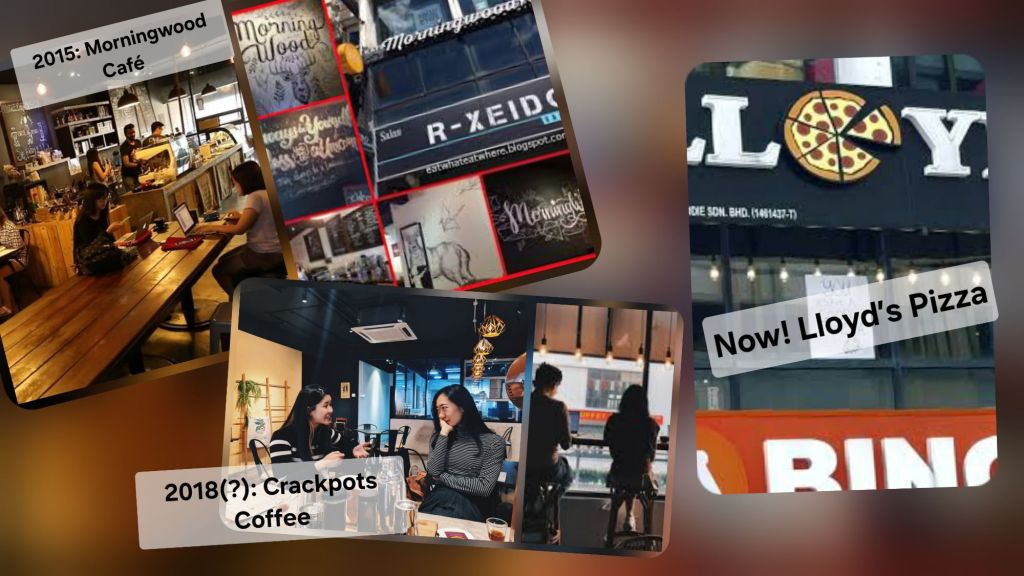
Somewhere between the froyo fade and boba takeover, the Morningwood Café opened its doors. A cheekily-named spot by Rueben Kang, Jared Lee, and Marianne Tan, Morningwood brought a youthful, creative charm to the café scene. It later changed hands many a times and was even a pasta joint before regaining a new life and being rebranded as Crackpots. Under new ownership, it became a favourite haunt of mine, thanks to its divine madeleines and exceptional coffee. The space evolved, much like SS15 itself. By late 2023, Crackpots relocated to USJ 1, and in its place now stands Lloyd’s Pizza, firing up slices where so many latte-fuelled afternoons once passed.
Post-pandemic, the tide turned again—this time towards wellness. Gen Z brought a new wave of health-conscious cafés and tea brands: Beautea, Koi Thé, and the ever-aesthetic Chagee ushered in an era of sugar-reduced, antioxidant-rich options. Aesthetic overdrive met functional beverages. Gone were the tapioca pearls; in came wolfberries and collagen jelly.
But SS15, ever the chameleon, wasn’t done yet. In 2023, something else started simmering—the Mee Tarik Cina Muslim craze. Pull noodles from the Chinese Muslim regions of China found a firm footing here. Their dishes were fragrant and hearty, but as a spice enthusiast, I must say the grilled skewers didn’t quite match up to the smoky charm of Balinese, British, or American marinades. Still, the novelty caught on.
Soon after, Nasi Lemak found itself in the limelight—again. Once a humble RM1.50 roadside staple, it became boutique. Fancy sambals, deluxe add-ons, and curated plating turned it into a premium dish. Shops began crafting an ambiance around it, leaning into vintage kopitiam vibes, while others went minimalist or rustic.
Then came the current chapter: hotpot. From China’s communal soup culture emerged Malatang—an entirely customisable broth experience where one selects their meats, veg, noodles, and condiments, all soaked in a fiery (fiery fires of hell spicy, if you like) or soothing broth. Whether dining in or taking away, it’s a two-hour affair that’s half-cooking class, half steamboat ritual.
In a way, this cycle of food trends mirrors our own shifts—our moods, our tastes, even our aspirations. Some trends faded quietly; others left lasting footprints. But through them all, SS15 thrived in its own chaotic, spirited way.
And perhaps that’s the charm—how a single street, tucked within the city’s sprawl, can hold a decade’s worth of flavours, friendships, and fads. In the end, this isn’t just about what we ate or drank. It’s about how the local tastebuds evolved with us. An outlandish optimism, if you will, that the next flavour will always be worth the try. Having said that, as I walk out for a next meal or snack, I do wonder what’s next for the streets of SS15.
How Genre Assignments Shape Storytelling Skills in Multimedia Students
What happens when film and animation students are handed an unfinished script and told to complete the ending—but with a twist? In my latest blog post, I dive into a dynamic storytelling challenge where students had to craft their own endings based on randomly assigned genres like comedy thriller, western, and true crime. This exercise wasn’t just about filling in the blanks; it was a deep dive into how genre constraints shape narratives, visual style, and creative problem-solving.
The challenge set the stage for their final project: creating a short film inspired by Wes Anderson’s iconic directorial style while incorporating a meaningful Sustainable Development Goal (SDG). From symmetrical shots and pastel palettes to dry humour and visual metaphors, the results were nothing short of brilliant.
Curious to see how genre-based learning enhances creativity in storytelling? Read the full article on Medium!
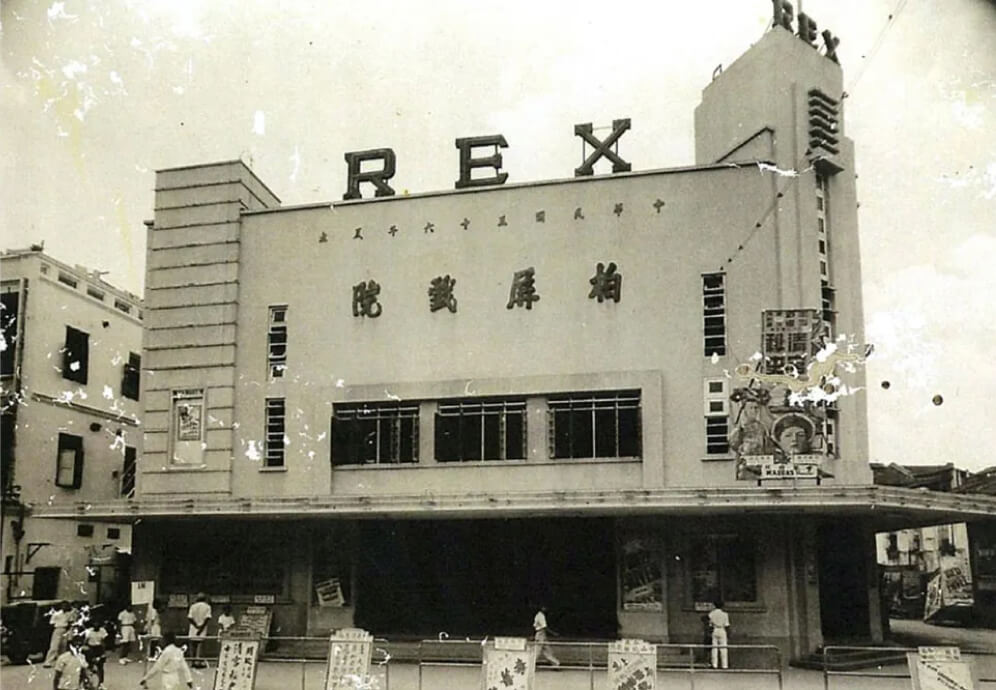
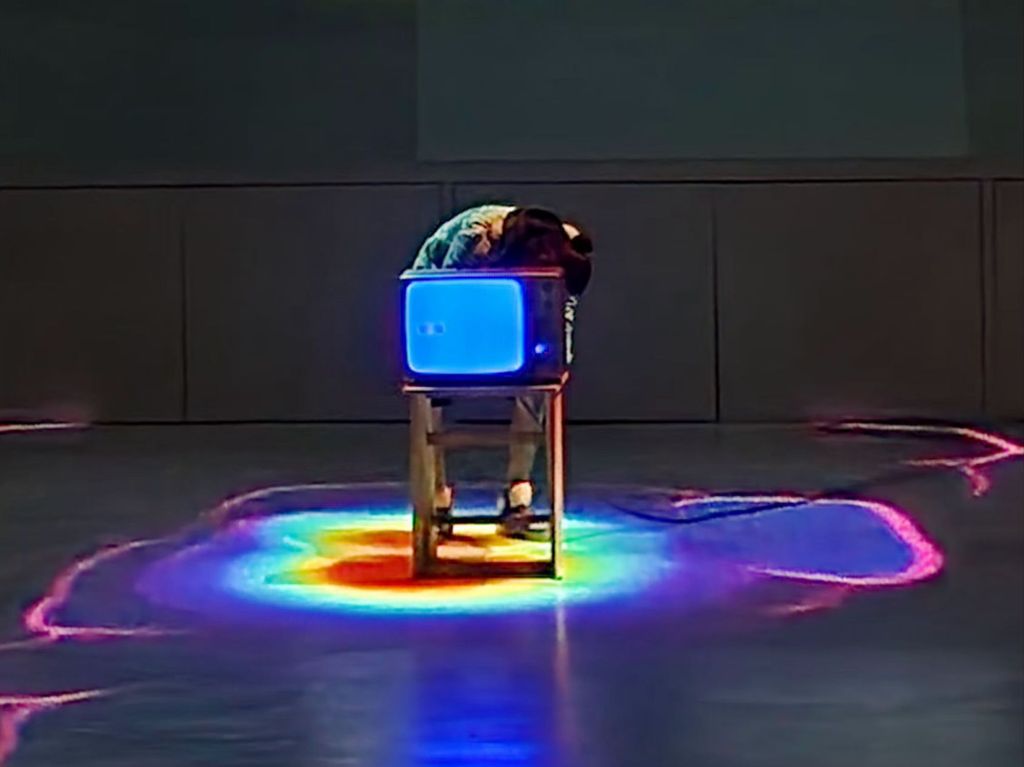
Imagine stepping into space where you don’t just hear the stories, but you feel them. Here, light, movement, and tradition come together to create an unmatched sensory experience. Students in their final semester of the Diploma in Multimedia with Animation Design (DIMA) at INTI Center of Art and Design (ICAD, INTI International College Subang) made this discovery. They had this realization during their visit to the Twilight Immersive Journey by REXPERIENCE. Located in the hub of the bustling city of Kuala Lumpur, “Rex Cinema,” once known for its film showings, has transitioned. It is now a community and cultural hub – REXKL. The space presents the transformative power of projection mapping. This feature serves not just as a visual treat but also as an educational touchstone for students. They are eager to apply these techniques to their own creative journey.
The original REX Theater was designed in 1947 by architect James Robert Vethavanam. It was then operated by the Shaw Brothers. Source: REXKL (www.rxpkl.com)
REXKL was once known as a historical site of one of the country’s first theaters. The original REX Theater first opened its doors on 28th July 1947 and was then operated by the Shaw Brothers. Unfortunately, in 1972 the building caught fire and burned down. GSC, then known as Golden Communications, took it over in 1976. It became the first cinema in Malaysia to have a digital sound processor system (DTS). This occurred with the release of ‘Jurassic Park’. Unfortunately, after two decades as the most popular cinema of its time, a fire destroyed the building again. It finally ceased operations on 5th November 2002. Over the years, it experienced ups and downs. In 2007, it was converted from a cinema to a backpackers hotel named Red Dragon Hostel. The building suffered another fire in the same year. It was revived in 2018 as an art and cultural center known as REXKL. Now, it hosts many community building and creative events. REXKL is catching up with time. It aligns with the current trends in season. REXKL introduces an immersive digital art gallery on her first floor – REXPERIENCE. In the expansive main hall that spans 8,800sqf, it brings to life a revolutionary traditional art viewing experience. This is achieved through the use of new and immersive cutting edge technological tools and systems.
The REXPERIENCE (RXP)
Taking a step into the reconditioned cinema hall was a breathtaking experience. The layout has been redeveloped. This allows visitors to inhale an interactive experience of light and sound. The cinema hall stretches from floor to ceiling. It has been transformed into an environmental corner. The space is fitted with projectors above and on the walls. Speakers engage her viewers with the astounding sound and music compositing. Movement sensors enhance the interactive experience. They transform her walls from a blank canvas to a colorful and storytelling experience.
The immersive setup awaiting the start of the show. Source: Klook
The immersive setup showed the potential of venue design to enhance storytelling. This is an essential lesson for students. They should consider how to curate spaces for greatest impact in their upcoming and future works. As the show begun its running, the feeling felt as though walking into a living storybook. We see this clearly. The students begun to notice how the projection on the floor fluidly mutated. It animated with their movements.
Moving to the slightest movements, an interactive visual experience is created with motion sensors.
Stories unfolded: the Art of Projection Mapping
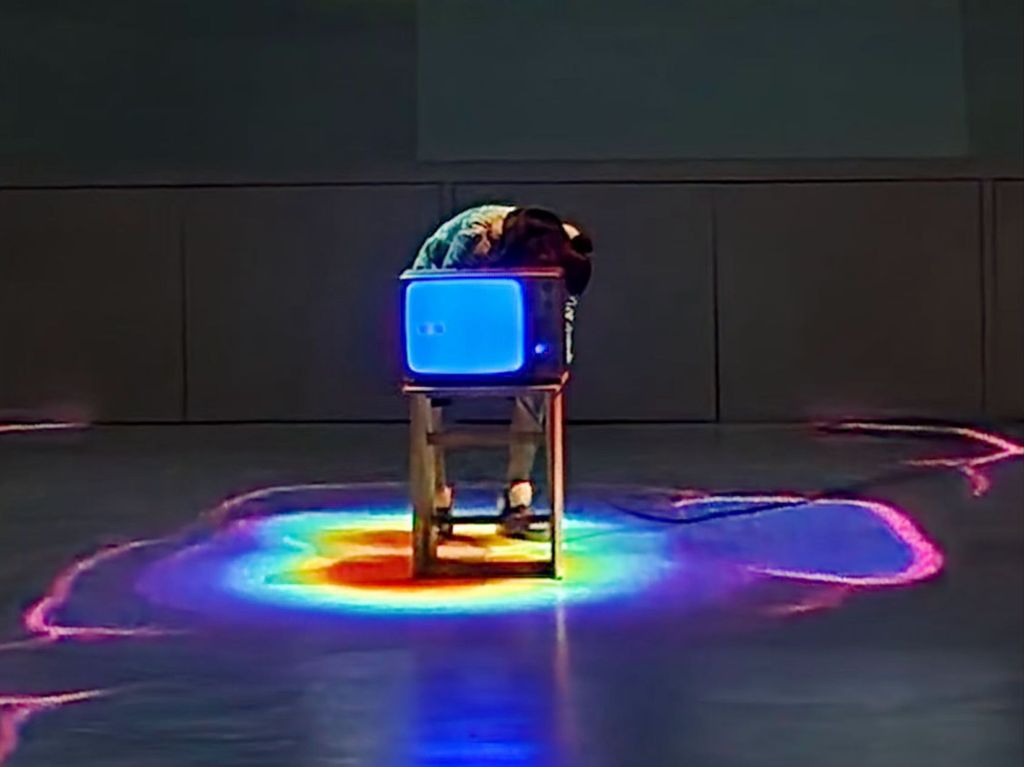
Three unique storytelling experiences are showcased this time under the titular TWILIGHT. The first is “Hanya Batik,” a narration through the eyes of a batik artist with visuals by Arif Rafhan. This is followed by “Geometry of Emotions” by Fabien Bauchard and Matthieu Pernaud with the support of Institut Français. Finally, “Escape” by Colas Fiszman and Laurent Delforge is presented in collaboration with RXP. Interestingly, RXP offers Live Performance choice and Regular Show choice. The students were signed on for the regular shows. A live dancer differentiated the two experiences. The dancer wore a special suit with motion detectors. These detectors captured and transmitted the movements into the “Escape” show. It was unfortunate that this experience was something not capable of being visualized during the regular show.
‘Hanya Batik’, a living tapestry of tradition and history
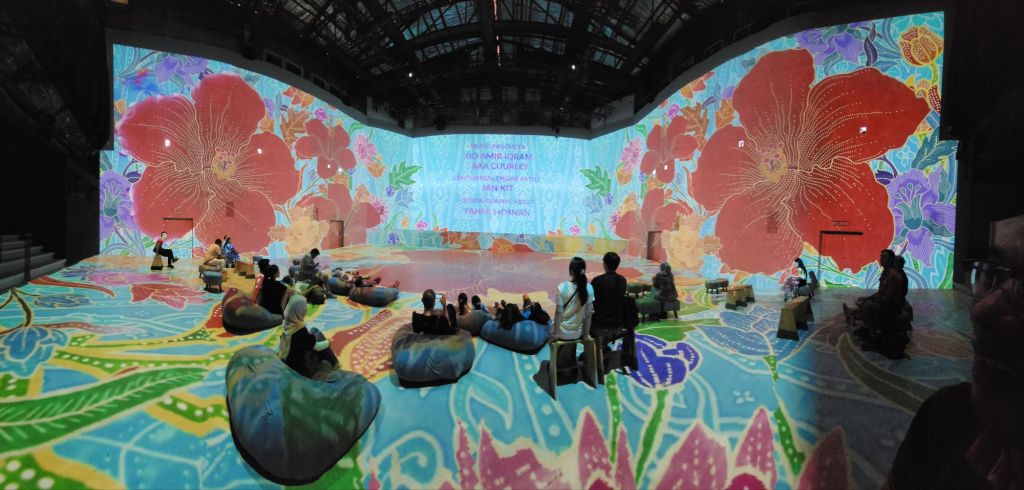
The colors and motifs painting the walls as the stories unfolded.
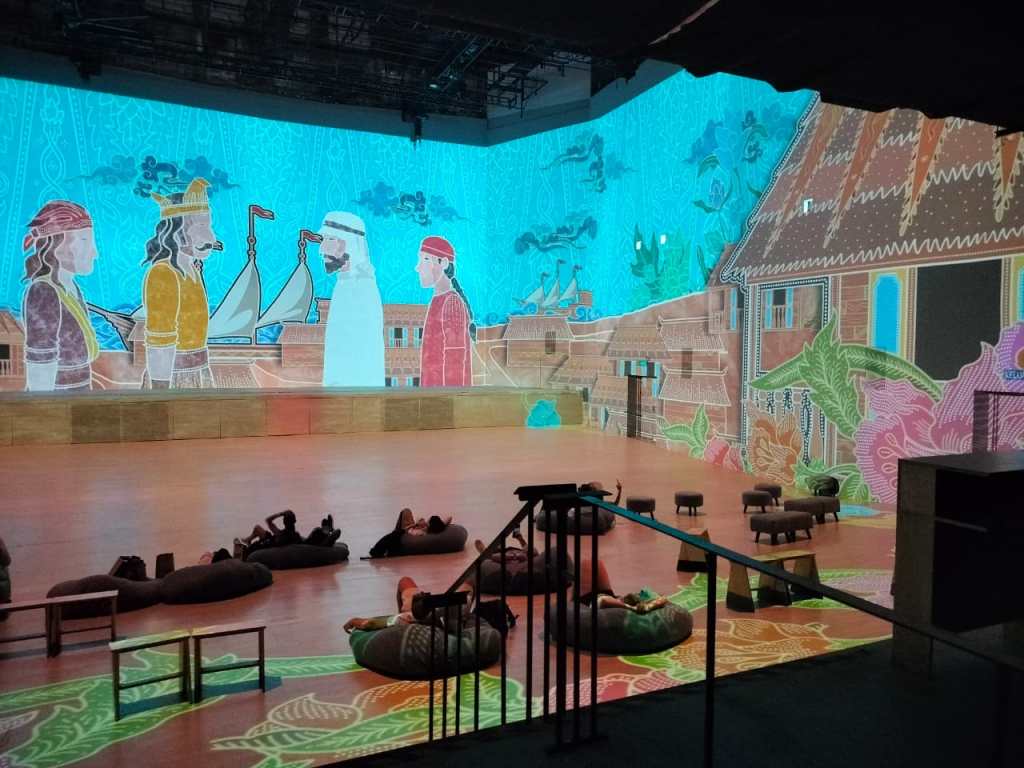
‘Hanya Batik’ showcased how heritage and modernity could coexist. As the light show begun, we embarked on a journey through Malaysia’s identity. It highlighted historical and contemporary narratives. Scenes ranged from the Malaccan Sultanate’s establishment to today’s dynamic urban life in Malaysia. Artists Arif Barhan, Bo Amir Iqram, Fahmi Hosnan and Ian Kit created and directed the show. The batik motifs charm audiences by bridging the traditional and modernization. This offers a visual celebration of cultural resilience as the narrative showcases influential Malaysian figures. Each frame illustrates a layer of authenticity. It highlights some Malaysian icons, like the Wau, hornbill, rafflesia, and hibiscus. This showcases a sense of continuity.
It evokes nostalgic feel towards it despite it being a modern piece. Traditional instruments like Kompang, Membranophone, Ghazal and Angklung can be heard playing at different point.
– Law Jer Lin, DIMA student
Overall, this segment encouraged students to think about how traditional crafts can inspire fresh, innovative animation techniques. The intricate use of batik motifs symbolized the importance of embracing cultural identity within design. It offered a clear takeaway: one does not need to look far to find inspiration. Inspiration can be rooted in one’s surroundings.
‘Geometry of Emotions’, visualizing emotions through geometry
‘YOU ARE HERE’ – a defining statement that place sets the audiences into a somewhat trippy sound and space.
Crafted by Fabien Bouchard (Parse/Error) and Matthieu Pernaud, with the Institut Français’s support, it presented a real-time interactive experience. This segment pushed the boundaries of engagement. It allowed the audience’s presence to influence the projections. This created a responsive dance of light and sound. For students, the piece showed how digital interactivity evokes emotions. It blended geometric precision with organic movement. This questioned the relationship between human feelings and technology. Additionally, the dynamic element demonstrated how immersive media can make a story feel more personal. Personally, it made it more impactful.
For example like emotional depth it shows into geometric forms can capture the complexity and shows the human feelings in a way more to profound. It shows how they can shift and evolve.
– Muhammad Haziq, DIMA student
By observing how real-time interaction was handled with seamless projection and sound, they learned new ideas. The students soon realized that such technology can be incorporated into their college projects. Furthermore, they considered using tools that track audience movements or changes in the environment.
‘Escape’, the play digital tools and virtual movements with daily life
In the last segment, ‘Escape’ invites the viewers to witness the impact of digital tools. It encourages them to think about virtual environments in daily life. The piece used advanced choreography with projection mapping. Unfortunately, the students were unable to view it due to the booking timing. This audiovisual experience by Colas Fiszman (Tyrell Studio) and Laurent Delforge (NONE Studio) presented a striking commentary on how modern culture shapes personal identity. It urged the audience to reconsider how their digital footprints affect them. As it showcased arrayed themes of technology, identity, and self-reflection.
Employing tools like TouchDesigner and Unreal Engine, it synchronised dance, electronic music, and generative projections to create an arresting, multi-sensory display.
I think the creator may have wanted to express the current predicament of humanity being trapped by constraints, using dance and electronic music to convey this message.
-Yap En Hui, DIMA student
This performance was a masterclass for students. It integrated choreography and projection mapping. It encouraged them to think about using digital tools to tell profound, human-centred stories. The piece integrated advanced choreography with projection mapping. It presented a striking commentary. Hence this commentary focused on how modern culture shapes personal identity.
The Creative Learning Curve
In general, the Twilight Immersive Journey sets an example. It shows how to generate and sustain interest through the thoughtful marriage of design elements. Be it a narrated historical storytelling like ‘Hanya Batik’ to the responsive and colour-tripping ‘Geometry of Emotions’ or the thought-provoking ‘Escape’ – each story maintained a seamless flow. It brought to students the importance of integrating audio-visual elements to create a unified yet captivating experience for the audience.
This experience has enlighten the students to think beyond the traditional norms of storytelling and encourages the use of new technologies. Taking time to deconstruct each segment, the show serves as a blueprint of sorts. A future for design education where students can draw inspiration to create their own immersive experience.
The Twilight Immersive Journey at REXKL highlights the boundless potential of projection mapping and underscores REXKL’s remarkable evolution. From its roots as a historic cinema hall to its current role as a dynamic creative hub, REXKL bridges heritage and innovation, offering a space where tradition meets cutting-edge storytelling.
For students and educators, this experience inspires a deeper exploration of how technology and narrative can coexist, serving as a catalyst for creativity and innovation in their own work. Events like these solidify REXKL’s role as a beacon of cultural and artistic growth in Malaysia. They foster collaboration and spark new ideas for the future.
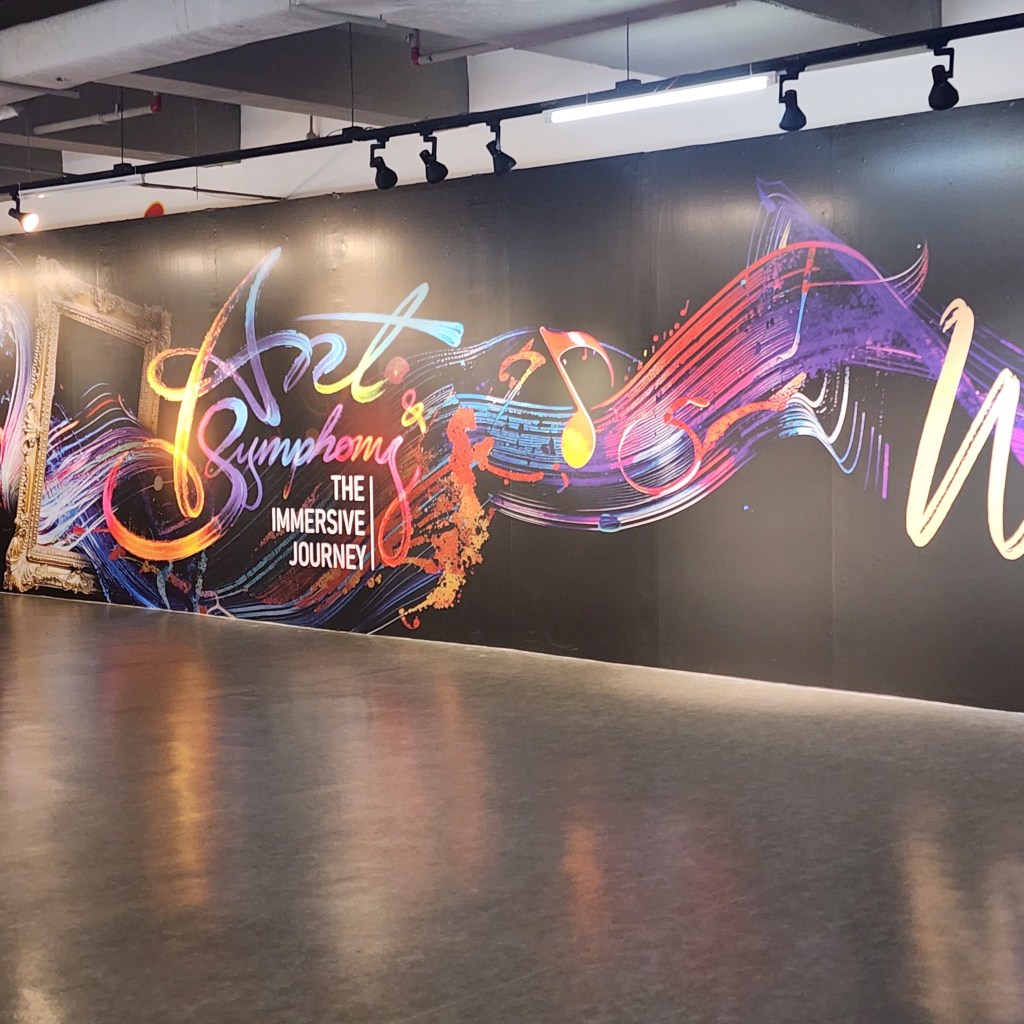
Recently, students from the Diploma in Digital Media Design, Diploma in Immersive Design, Foundation in Design, and Diploma in Graphic Design embarked on a field trip far beyond the traditional classroom. Their destination: the Art and Symphony Immersive Exhibition, a cutting-edge event that combines the worlds of classical art, music, and interactive media that was being showcased at Fahrenheit 88, Kuala Lumpur. This exhibition offered students a rich journey into the depths of multimedia design, showcasing how modern technology can bring age-old art and music to life. For these budding creatives, it was a chance to absorb and engage with animation, sound, and experiential design concepts they could carry into their work.
From the moment the students entered the space, they were met with installations that defied ordinary observation, drawing them in as active participants. Interactions, in particular, played a crucial role in many of the rooms as the marriage of music and visuals evoked a powerful emotional effect for the many who trod through the man-made hallway setup. A memorable highlight was an interactive sound-powered exhibit, where retrofitted microphones allowed each voice to leave a unique artistic imprint. Visitors could sing, speak, or even shout, watching as colours danced and changed in response to pitch, while fans adjusted floating scarves that would rise higher with each louder note, creating a mesmerising and immediate link between sound and visual design.
In spaces dedicated to iconic artists like Monet and Van Gogh, the immersive experience continued. Here, students could step into re-creations of famous paintings, almost as if they’d walked straight into a masterpiece. Visitors could even see themselves transformed into an Impressionist-style portrait—a stunning feat achieved through advanced camera and programming technology. It was an unforgettable experience to see classical art through a modern lens, underscoring the way technology has opened new doors for creative expression.
Entranced by the setup strong inspired by Monet’s floral paintings. Students could picture themselves in a secret garden of floral beauty. Credit: Darwinraj Jayakumar
A Lesson in Art, Sound, and History
From an educational perspective, this trip encouraged students to engage critically with each exhibit. They were prompted to dissect the technical applications, from soundscapes to AI-assisted artistry, and to appreciate the role of art’s great maestros in shaping creative expression. This encounter with AI-generated art, mirroring historical styles, offered inspiration for their upcoming projects, giving students a fresh take on using new tools while respecting classical influences.
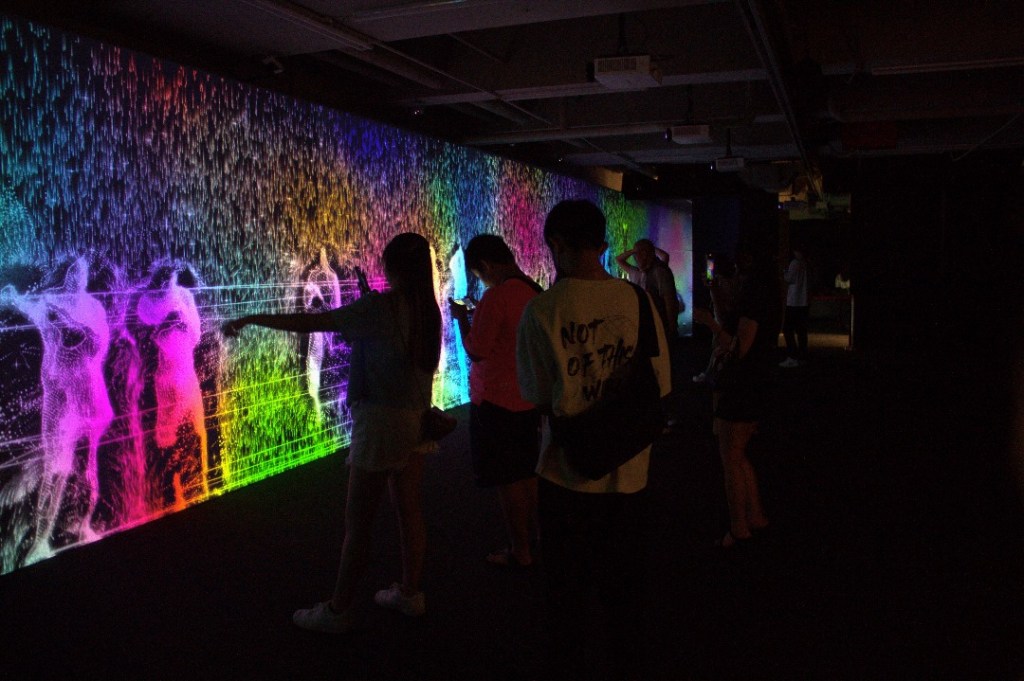
Students interacting with the screen. The entire installation reacts to sound and the movements through the detection of motion sensors. Credit: Damien Lo Chang Yang
For some, the exhibition inspired insights into colour theory and atmosphere, showing how colours can convey mood just as colour grading does in film. Others found inspiration in the harmonious blend of sound effects and music, sparking ideas to experiment with audio-visual elements in their own storytelling projects. A standout sentiment shared by many was the exhibition’s immersive quality. One student expressed it perfectly: “It really pulled you in by engaging all your senses—mixing music, visuals, and maybe even some interactive elements to create a unified vibe. The large-scale visuals paired with the perfectly timed sound made you feel like you were part of the experience, not just watching from the outside.”
In overall, the Art and Symphony Immersive Exhibition offered more than an artistic showcase; it provided students with a profound lesson on the possibilities of blending tradition with technology. By experiencing how multimedia can enhance storytelling and evoke emotion, students walked away with a deeper understanding of how they, too, might push boundaries in their work. For these students, this trip was a first step in transforming theory into practice, giving them the tools to take creative risks and explore new dimensions of design.
In learning the art of storytelling by animation, I have discovered that language has an anatomy – Walt Disney
Some say telling stories is a gift, and some say it comes with reading. However, telling stories doesn’t mean you need to hold a pen and write it, perhaps you do need to craft a skeleton in point form. That said, in this write-up, I’ll be sharing on incorporating creative storytelling basics into my students’ projects for both my course subjects – Digital Video and Digital Animation 1 (2D Animation). I will focus on how the narrative thread weaves everything together, giving the project purpose and direction.
For the semester of April 2024, I was entrusted with teaching Digital Video and Digital Animation 1 where the students are guided and trained in the technical aspects of production. Students are trained to observe and use the basic tools to craft a production that is worthy of commercial value. Nonetheless, keeping to my main focus, I’ll discuss how I guide my students to incorporate storytelling into their work, ensuring they not only engage their audience but also effectively convey their intended message.
Every story begins with a core idea or message.
Before diving into any exercise be it a simple class exercise, assignment or project, I make it a point to consider their driven goal – what they want their audience to feel or understand. This could be an emotional journey, a moral lesson, or even a simple yet powerful statement. The key is for them to have a clear understanding of the “why” behind their story, as this becomes the foundation upon which all other elements are built. To further emphasize this a small case study discussion is shared in the class that features some existing productions that ranges from amateur work to professionally.
One of the Case Study Animation featuring “Sundown” by GOBELINS Production
As a good story needs a beginning, middle, and end—a structure that helps guide the audience through the narrative, it’s also crucial to have well-developed characters and a compelling setting. In this case, we can delve deeper into how Shiki’s winning entry “Banana Kid” not only addresses the issue of youngsters struggling with their mother tongue, but also explores the broader themes of cultural identity and the challenges of navigating between different cultural worlds. She demonstrates a creative narrative build-up through her character development with the support sound and music effects with color treatments.
Another Case Study featuring a proud Graduate of ICAD – Khoo Shiki and her TISDC Honorable Mention 2023 “Banana Kid” along with her instructor and my fellow colleague, John Ho who provided the guidance throughout the project period.
That said, in Digital Video, this structure is crucial as it dictates the pacing and flow of the film; and for 2D Animation, the structure helps in planning scenes, character development, and key animation sequences. Bringing this into practice, I often ask my students to create a storyboard or a simple outline before they begin their projects. This not only keeps their ideas organized but also ensures that the story remains cohesive and doesn’t lose its direction as they move forward. It also engages and captures the students’ remembering skills as the constant practice of storyboarding and/or outlining prior to a project would become an innate practice.
Characters are the vessels through which stories are told.
Whether it’s a protagonist or an antagonist, or in simpler terms a hero or a villain in a short film or a figure in an animation, well-developed characters bring depth to the narrative with a strong tendency to carve an impact into its audiences. Taking into thought, we have some of the famous characters that are now icons created during the Golden Age of Animation era such like Mickey Mouse, Donald Duck, Bugs Bunny or the newfound screen heroes and villains (Ironman, Captain America, Thanos, etc.) made known by the Marvel Cinematic Universe. Thus, I encourage my students to think beyond surface traits and explore their characters’ motivations, backstories, and arcs. In 2D Animation, this might involve designing characters whose visual elements reflect their personalities or roles in the story. In Digital Video, it’s about capturing these traits through performance, dialogue, and visual cues.
When delving into Digital Video and 2D Animation, the visual aspect of storytelling is paramount. My students learn to use color, composition, and movement to convey mood and emotion. For example, in a 2D Animation project, a scene might shift from warm tones to cool tones to reflect a change in a character’s emotional state. In Digital Video, camera angles and lighting are tools that help tell the story without needing words. I push my students to think about how every visual element they choose contributes to the overall narrative.
Drawing emotional “call-to-action” with SDGs
In today’s world, creative storytelling isn’t just about entertainment—it’s also a powerful tool for raising awareness and promoting change to mindsets and societies. As educators, we too have a responsibility to prepare our students not only for their careers but also for their roles as global citizens and role inspirational models. That’s why I emphasize the importance of integrating the United Nations Sustainable Development Goals (SDGs) into their projects.
With the emergence of the SDGs in Rio de Janeiro, Brazil in 2021, we would notice how it covers a wide range of global challenges, from climate action to gender equality, and offers a rich source of inspiration for storytelling. By educating my students about these goals, I encourage them to think critically about the world around them and use their projects as platforms for advocacy. Whether it’s highlighting the impact of environmental degradation in a Digital Video project or addressing social justice issues through a 2D Animation, the thought and act of incorporating the SDGs allows students to add depth and relevance to their stories.
Visual storytelling of one kind or another has been around since cavemen were drawing on the walls – Frank Darabont
Additionally, this approach helps students understand the broader aspects in which their work exists. It pushes them to reflect and consider the societal impact of their stories and to create content that not only for entertainment but also serves to informs and inspires action. The educational focus on the SDGs ensures that the stories my students tell are not just creative, but also meaningful and aligned with the global efforts towards a more sustainable and equitable future.
Moving forward, I incorporated the theme of International Design Day 2024, “Is it Kind?” into my teaching. Through the subtle insertion of this theme, students were encouraged to reflect on the ethical dimensions of their creative work, prompting them to ask themselves: Does the story they are telling promote kindness? Does it foster understanding, empathy, and positive change?
Through this incorporation into their projects, the students were able to ensure that their narratives contributed to a kinder, more compassionate world, be it addressing serious global issues or crafting light-hearted animations. Additionally this prompt made openings for me to guide them into driving the underlying messages to be aligned not only with the IDD 2024 theme but also the Taiwan International Student Design Competition 2024 wherein the driven theme was “Equality”. This reflective practice aided students to understand that storytelling showcases more than creativity – it is also about responsibility.
Storytelling is the most powerful way to put ideas into the world today – Robert McAfee Brown
That being said, I’d like to highlight some of the exemplary works created by my students. These projects demonstrated the integration of creative storytelling, the SDGs and the mentioned themes. Hence being able to demonstrate how, with thoughtful guidance, students can achieve creative yet powerful narratives that desires to resonate with the audience and to inspire a positive change in society.
Puppet by Lim Yi Yan, Koo Yin Thong, Ng Xin Di & Wong Zheng Yi, current students in Diploma in Digital Media Design, ICAD, INTI International College Subang.
Puppet – Lim Yi Yan, Koo Yin Thong, Ng Xin Di, Wong Zheng Yi: This short tackles the theme of women empowerment, while subtly weaving in the elements of equality and the need for mental wellness. The narrative arc is tightly structured with the emphasis of signs and symbols incorporated to compel deeply with the audience.
Work & Play – Tursina Mohd Zain, Jamie Allyson Tan, Koo Jia Jet: Focused on the theme of good health and well-being, this animated short uses innovative visual storytelling techniques to address how one may be driven into a pitfall due to negligence and pressure. The use of simple lines, colors and composition is particularly noteworthy, as it enhances the emotional impact of the story.
Black Cat – Tan Shi Jie, Lim Shun Khor, Boo Yu Xuan, Tee Jun Yong: Addressing the theme of kindness towards animals, this animation stands out for its strong alignment with the SDGs, particularly Goals 4 and 12. The story is told with a sense of empathy and understanding, encouraging the audience to reflect on their own actions and behaviors.
A Change for the Better – Ashley Teh, Karina Boltenkova: A creative exploration of color and treatment to achieve the Wong Kar Wai-feel while pushing the boundaries of traditional narrative structures. The desired theme to address in this film strongly resonates with Goal 8 while desiring to resonate a voice for the silent among the audience.
While certain storytelling principles remain consistent, I believe in fostering a classroom environment where students have the creative freedom to explore and experiment with the tools and techniques provided. This might involve exploring non-linear narratives, abstract visual styles, or unconventional storytelling techniques inspired by some of the renowned directors in the entertainment world. Both Digital Video and Digital Animation offer ample opportunities for innovation and with an added push, I would encourage my students to challenge the boundaries of traditional storytelling. Therefore, aiding them to develop their unique voices while also preparing them for the dynamacy and demands of the creative industry.
A Change for Better by Ashley Teh & Karina Boltenkova, current students in Diploma in Immersive Design, ICAD, INTI International College Subang.
Teaching creative storytelling is more than just guiding students through scripts or sequences of images – it is about leading them in a way to connect with their audience on an emotional level. Hence, further emphasizing my goal to instill in my students the skills to craft experiences that sings, whether they choose to follow traditional path to carve out new storytelling approaches. Through the integration of the SDGs and the various themes, my students not only become skilled storytellers but also thoughtful, responsible creators who understand the power of their work can influence a new shape to a better world.
Writing has been a subtle joy for me as I am able to dictate into words the places I go to the people I meet. As it goes on, this will be the second year in which I am able to share this writing passion of mine as part of the TAPE Magazine Team at INTI Center of Art and Design (ICAD).
Read all about it here.
In this first issue for 2024, the team had collectively decided to delve into matters and drive discussions in line with the International Design Day theme “Is It Kind?” And with that thought in mind, I was gladden at the chance to interview an old student of mine, Hafiz Hakim, whom I saw grow in knowledge and skills from our very own ICAD’s Foundation in Design programme into the Bachelor of Arts (Honours) Interior Design in Collaboration with Sheffield Hallam Univesity. Although fairly new to the industry, Hafiz shares on how his creative perception has evolved through the years from hia educational journey into the périls of the creative industry.
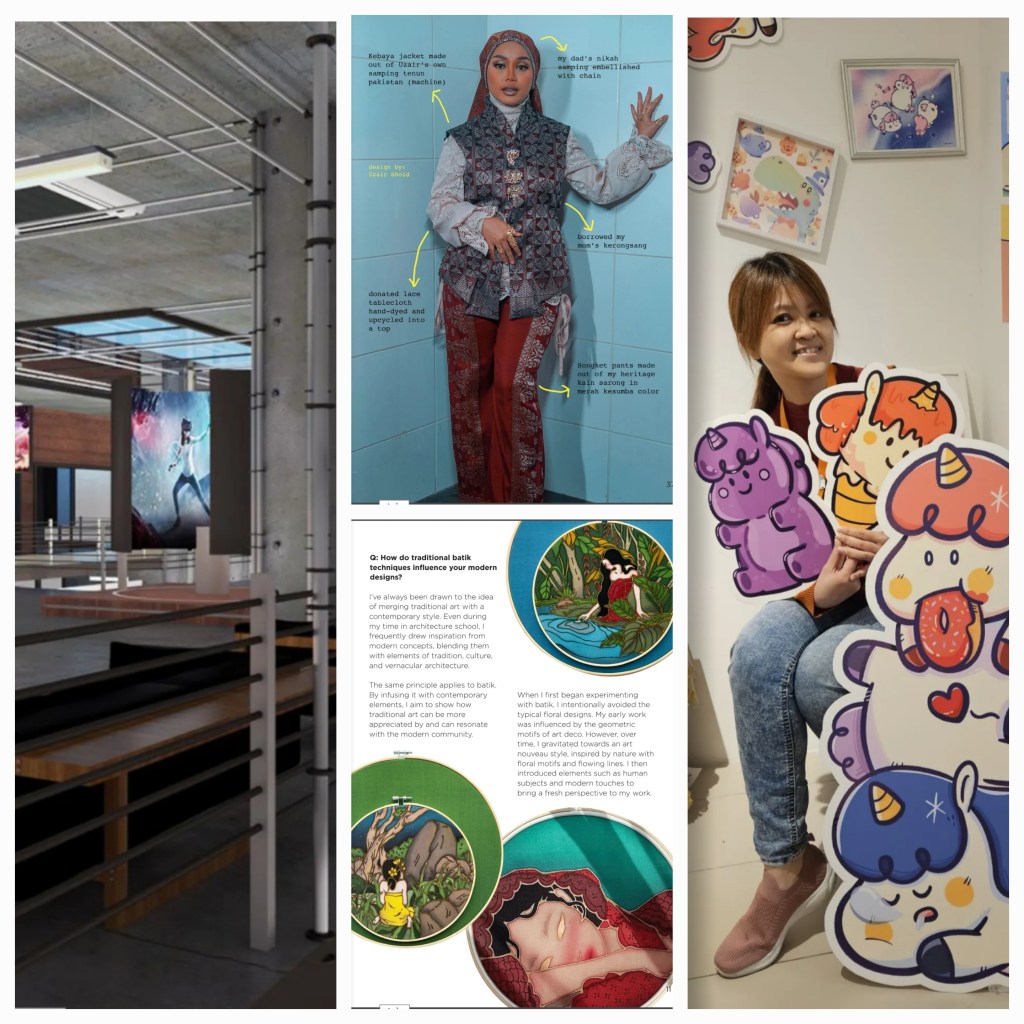
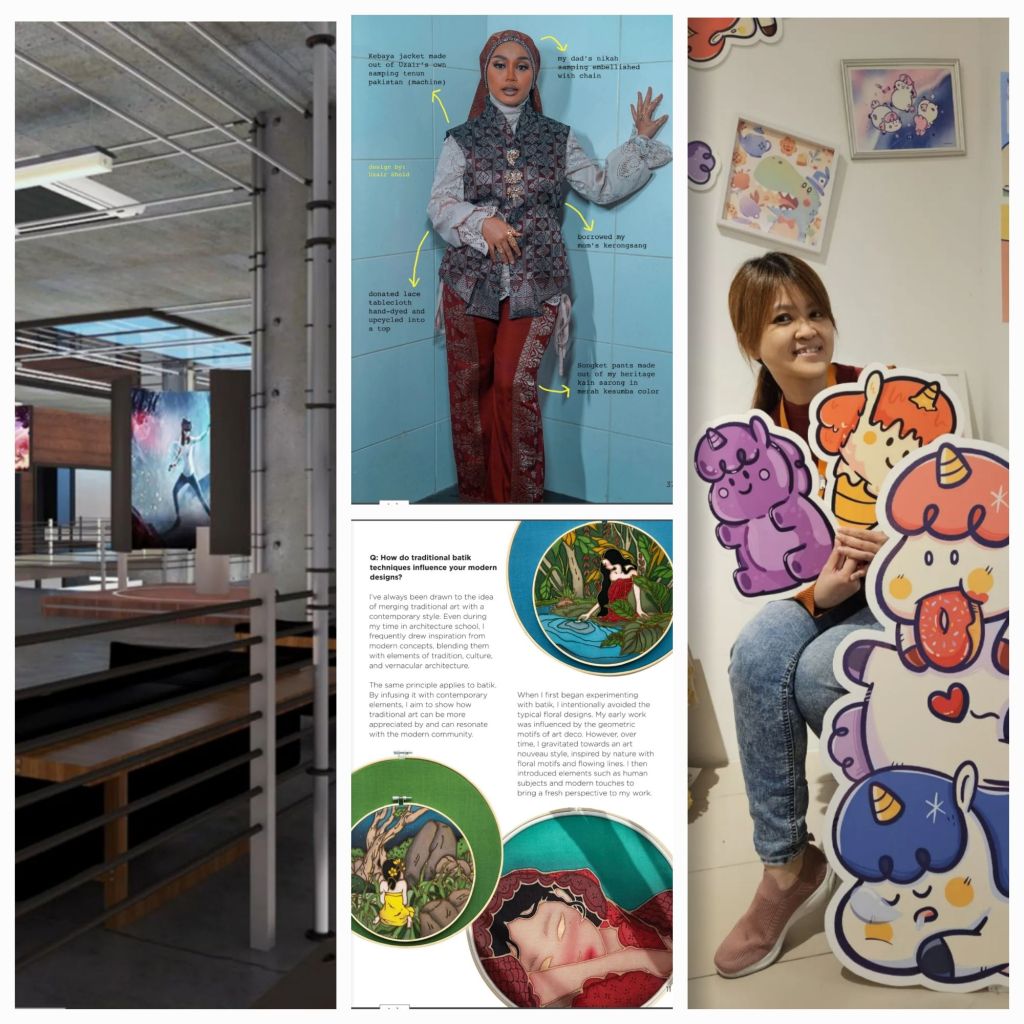
(Clockwise) Excerpt from our Special Feature Designer, Yeo Sue-Jane aka. OhDoodlez, insights with Novak Batik, and one of the works of Hafiz Hakim.
Indulging further into the art scenes, my fellow colleague Reia had the grand opportunity to interview a batik muse, Novak Batik. She shares how she has grown through the years and the collaborations accomplished, to name a few – Samsung, Gucci, Converse, and many more. Her journey and creative process truly inspire as she narrates her genuine aspirations to grow through learning from mistakes.
Taking in on the scenic and deep appreciation for local architecture is another colleague Adleena as she shares on the prime restoration to glory of Semua House, KL. A long forgotten building that once stood in the heart of KL’s textile hustle & bustle, today the refurbished Semua House stands as the latest hangout for young families and their elders.
Last but not forgetting, a special mention to another colleague whom I had the chance to interview – Yeo Sue-Jane but better known to her fans as ohDoodlez. I was deeply honoured to have gotten a closer in-depth into her not just as an art educator and fellow colleague but also as a fellow artist.
Creativity is seeing what others see and thinking what no one else thought – Albert Einstein
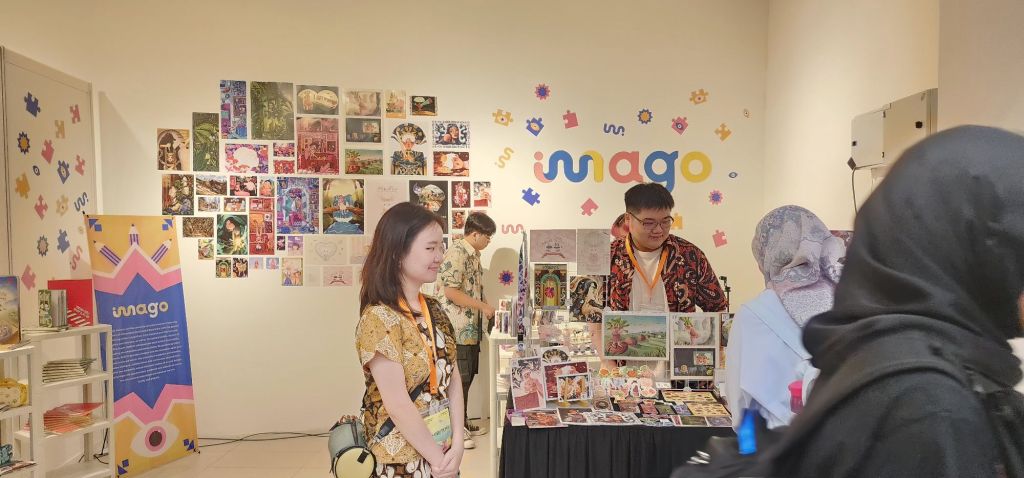
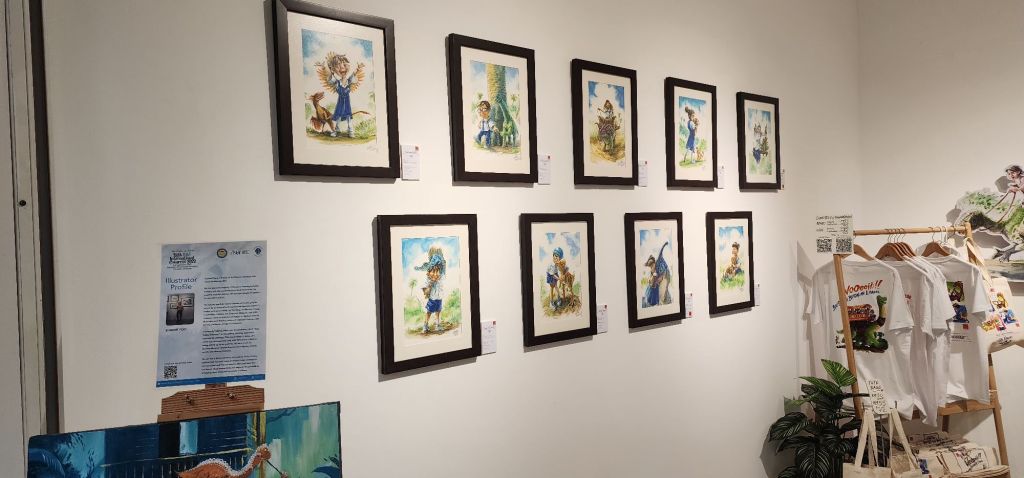
Artists up and about selling their handiworks to the many enthusiast at the fair.
The Kuala Lumpur Illustration Fair (KLIF) is back again and so were we the troopers from INTI Center of Art and Design Subang (ICAD). There is nothing more sweeter than academics, gathering students into a band to fieldtrip an art fair for inspirations, kicks and most importantly, in support of other artist whether they are near or far. This year however was a little more special than the previous as our fellow ICAD Graphic Design lecturers had secured themselves a small space to sell their pieces.
Amazingly, GMBB was packed from the carpark to the event floors. It was great as the event turnout of both art vendors and art enthuasiasts seemed better than the year before. Interestingly there were many new faces exhibiting their works as well as selling and added to that were ICAD’s very own lecturers – Mr Sean Lee, Programme Head for Graphic Design; and lecturers, Mr Chris Tan and Ms Yeo Sue-Jane. With this, Tape Magazine received the rabbit’s foot of luck and got an exclusive with the ever-loving Ms Yeo Sue-Jane.
1. How does your illustrations promote kindness in design, especially regarding sustainability and ethical practices?
My journey as an illustrator is deeply rooted in the enchanting tales and vibrant illustrations of my childhood. Enid Blyton’s books were my constant companions, filling my days with wonder and joy. Their whimsical narratives and captivating illustrations left an impact on my creative spirit and so I try to infuse my illustrations with the same sense of magic.
Kindness, to me, is about spreading positivity and joy through my art. Just as those beloved storybooks brought happiness to my life, I aspire to evoke similar feelings in others through my illustrations. Whether it’s through uplifting characters or heartwarming scenes, I hope to create visuals that resonate with people and hopefully brighten their day.
I believe that by infusing my work with warmth and optimism, I can inspire others to embrace these values too.
Ultimately, my goal is simple: to bring a smile to someone’s face and spread a little bit of joy with every stroke. Through storytelling and illustration, I hope to make the world a brighter and kinder place, one scene at a time.
2. How do you teach kindness in design as both an artist and lecturer?
As both an artist and lecturer, I try to instill kindness in design by cultivating a sense of empathy among my students. I stress the importance of understanding diverse perspectives within their target audience, encouraging them to explore beyond surface-level aesthetics.
I think it’s important to equip students with the mindset and skills to become not just skilled designers, but compassionate advocates for positive impact. By emphasizing empathy as part of the design process, I try to encourage them to create designs that are not only visually stunning but also deeply considerate of the audience.
3. Can you give examples of how your designs benefit the environment, communities, or future generations?
As a designer, I firmly believe that our roles extend beyond simply creating visuals; we have a responsibility to leverage our skills and influence to contribute to larger causes.
In my recent involvement with ‘A Christmas Thingy,’ I had the opportunity to contribute to a project that truly made a positive impact on communities. Working closely with a dedicated team, I played a key role in both the planning and design phases of the initiative, which aimed to bring joy to underprivileged communities during the Christmas season.
By providing gifts, meals, and festive activities, we brought moments of happiness and togetherness to those who may have otherwise felt marginalized or forgotten during the holiday season.
4. Can you share a project where you prioritized kindness in design?
One of my recent illustrations, titled ‘Bee Nice,’ was inspired by the idea of God’s assurance and self-compassion during an emotional time. Amidst all the outward empathy towards others, I believe it is also important to be kind to oneself as a foundation for spreading kindness to others. This was an expression of self-love and empathy.
Through sharing my personal journey of self-discovery and spiritual growth, I found that vulnerability could also be a catalyst for meaningful conversations about mental health, well-being, and the importance of self-compassion. By prioritizing these values, I not only nurtured a deeper sense of self-awareness within myself but also created an opportunity to inspire others to cultivate kindness and empathy towards themselves and towards others.
5. How do you balance artistic expression with social and environmental responsibility?
I find that by continuously reflecting on my artistic practice and considering its impact on society, I have become more mindful and selective about what I choose to share on social media. I am aware of the significant influence it can have, especially now that I have a larger following. Some aspects of my work are best kept offline, but I remain informed about emerging issues and evolving practices, and I’m open to adjusting my approach to align with my personal values.
Even if I don’t explicitly showcase kindness through my artworks sometimes, I try to advocate for it through my actions and interactions in real life. I believe that the way I uphold myself and treat others can speak volumes, contributing to a positive influence beyond the confines of my art.
6. What role do designers and makers play in addressing global challenges like climate change and inequality?
Designers and makers have a significant influence in shaping cultural norms and values through their creations. By advocating for positivity, diversity, and inclusivity in their works, they can promote messages of love and acceptance, while also challenging harmful stereotypes and biases.
Being mindful and responsible about the impact their creations may have on their audience is paramount. Whether they are spreading love or hate, designers and makers must recognize the power they hold and learn to use it responsibly. By considering the potential effects of their work and actively choosing to promote kindness and empathy, they can contribute to a more compassionate and understanding society.
7. What do you hope for the future of design, and how will kindness continue to influence it?
I hope that in the future, there will be more collaboration across different design disciplines, rather than a creative community that is so segregated by practices. This is key to effecting meaningful change. By sharing knowledge, resources, and experiences, designers and makers can create opportunities to educate and raise awareness about the issues they care about, as meaningful conversations fostered through these kinds of collaboration can inspire a collective action towards a better world.
This article was written for the Tape Magazine, an initiative publication by INTI Center of Art and Design (ICAD), INTI International College Subang
How do we change the world? One random Act of Kindness at a time. – Morgan Freeman
(From left to right) A discussion forum led by Ms. Adleena Aishah, ICAD Fashion Lecturer and our esteemed guests – Mr. Asri Ahmad (Rifaie Chua & Sethi Sdn. Bhd.), Mr. Will Sii (We Post, We Care!), and Mr. Razak Aziz (SEEDS Malaysia)
Celebrating design has been and will be an annual affair celebrated at INTI Center of Art & Design (ICAD) Subang and once again the International Design Day is back with a calling theme “Is it Kind?“. According to the International Council of Design (ICo-D), the driven theme for 2024 aims to drive a kinder future for all and this inspired the organizing team to plan and execute several events to liven the hearts into giving back to society.
Impressing kindness that ‘priotises human welfare, sustainability, and inclusivity’ as mentioned by Helena Trampe in Design Matters is truly a drawing point needed addressing in the society of today. The emphasis on prioritizing human welfare, sustainability, and inclusivity in design and art has become increasingly important as we navigate the complexities of our modern world. Helena Trampe’s insights shed light on the potential for creativity to serve as a powerful force for positive change, inspiring individuals and communities to embrace kindness as a foundational value. Harnessing the theme “Bringing Kindness through Art and Design” as the celebrated theme by ICAD, the organizing committee of the event has demonstrated a commitment to fostering a culture of empathy and compassion through creative expression. That said, the working committee worked hard in stitching together several activities to instill the thoughts of kindness in the youths of today.
Drawing on the theme of kindness, the event showcased an art installation to grow excitement and drive the focus of “cross-pollination of ideas” to promote collaboration and innovation. An array of artworks by the students from various disciplines in ICAD titled “Framing Kindness” was featured, emphasizing collaboration and exchange of diverse perspectives to facilitate the growth of kindness in our ever-changing world. This fosters a sense of interconnectedness and understanding among individuals and across communities, with ideas painted into an art installation featuring works by the lecturer and students of ICAD.
As kindness is not only an individual trait, but a collective endeavor that can be nurtured through shared experiences and collective action. These thoughts and experiences were shared throughout the sharing sessions by our esteemed guests. We were honored to have Mr. Will Sii of We Post, We Care, who shared on how he was inspired to start a Postcard station to keep the spirit of sending traditional mail either to someone or one’s own self. Then, we also had Mr. Abdul Razak Aziz, who shared on the growing inspirations behind SEEDS Malaysia – a humble family-owned enterprise that focuses on bringing sustainability and helping all peoples to achieve their environmental goals. Finally, joining in the sharing was Mr. Asri Ahmad, who shared on the contribution of design to society. All in all, the esteemed guests were gathered into a discussion with ICAD’s very own fashion lecturer, Ms. Adleena, to further delve into the topic of kindness in society today and how it can be further expanded.
Mr Will Sii, sharing his story of founding We Post, We Care
Among the various activities and discussions, a concerted effort is made to explore how art and design can contribute to meaningful social impact, highlighting the potential for these creative disciplines to address pressing issues and uplift marginalized voices. This was brought together in the “Reaching Kindness” Art Bazaar, where the intersection of art, design, and kindness was brought together by the local artists of We Post, We Care and Bezpop. As the theme serves as a catalyst for positive change, offering new pathways for addressing societal challenges and promoting inclusivity and sustainability, profits made from the sales were designated to support the Budimas Charitable Foundation.
As we continue to navigate the complexities of the modern era, the significance of prioritizing kindness in our artistic and design endeavors becomes increasingly apparent, serving as a beacon of hope and inspiration for a more compassionate and equitable future.
This article was written for the Tape Magazine, an initiative publication by INTI Center of Art and Design (ICAD), INTI International College Subang
“It’s your place in the world; it’s your life. Go on and do all you can with it, and make it the life you want to live.”
Mae Jemison
Kickstarting the year’s planner at INTI Center of Art and Design, the faculty had the opportunity to invite Evita to share on life after graduating from the Multimedia course. She shared the various jobs and tasks she had undertaken, which also included her challenges in the industry. Among them were the issues of communication with the client and taking time to read the briefs to better understand the message needed to be delivered to its targeted audience.
Evita’s experience with remote working sheds light on the complexities that can arise when transitioning from a traditional office setting to a virtual work environment. Her reflections underscore the importance of effective communication and the potential feelings of isolation that can accompany remote work. Despite the convenience it offers, working from home may not align with everyone’s preferences, as demonstrated by Evita’s assertion that it is “not my style.” These insights prompt us to consider the diverse experiences and challenges that individuals may encounter while adapting to remote work arrangements.
Moving on, she found herself handling corporate events and using some of the common practices she was introduced to during her studies, like creating mood boards. Evita stressed how effective it is, as it gives a general idea of how the final outcome should look and feel, rather than groping in the dark. Taking in the new knowledge, as a lead for the conference event managing, accountability over keeping to the guidelines and timelines set to achieve a successful launch.
Deep inside, Evita found her voice in designing and planning for social media and in particular for the client’s request for achieving a glamorous and luxurious feel similar to brands like Tiffany & Co. and Thomas Sabo. However, the client was highly meticulous, and Evita found herself working on revisions after working hours. Evita’s creative journey was filled with challenges and triumphs. As she meticulously crafted each social media post, she drew inspiration from the elegance of iconic brands like Tiffany & Co. and Thomas Sabo. Her dedication to fulfilling the client’s vision led her to invest extra hours in refining each detail, ensuring that every aspect exuded the desired glamorous and luxurious ambiance. Despite the demanding nature of the client’s requests, Evita remained determined to surpass expectations and deliver a social media presence that resonated with opulence and sophistication. Through her unwavering commitment and passion for design, she transformed the client’s aspirations into captivating visual narratives, infusing each post with the allure and refinement reminiscent of elite luxury brands.
“Reflecting back on all the jobs, projects, and freelances she has managed, communication is key. One can never run away from working with clients to realize their dreams in a creative and visual manner.”
Taking a moment to look back at the myriad of professional experiences she has navigated, it becomes evident that effective communication has been a constant underpinning factor. From guiding intricate projects to nurturing freelance endeavors, the art of conveying ideas, expectations, and feedback has proven to be indispensable. Whether orchestrating the realization of a client’s vision or conceptualizing a visually compelling creation, the seamless exchange of thoughts and concepts has always been central to every success. This enduring truth reaffirms the intrinsic value of clear and purposeful communication in bringing imaginative aspirations to life.
We wholeheartedly thank Evita for her insightful sharing and perhaps in the future will have an opportunity for a collaboration. It’s truly inspiring to see such passion and dedication to the work. Evita’s expertise and unique perspective have certainly enriched our discussions, and we look forward to the possibility of joining forces on future projects that would possibly enrich the students’ learning experience.